
Pips vs points vs ticks: the 5-digit broker confusion
MT5 counts in points, not pips. On a 5-digit broker a point is a tenth of a pip, so a spread of 12 is 1.2 pips. How to tell pips, points and ticks apart.
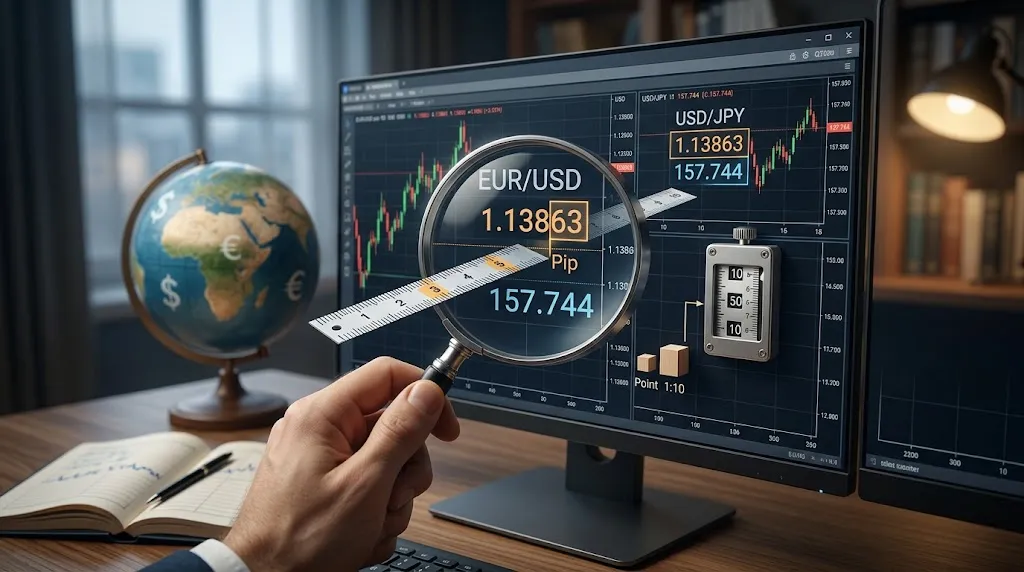
Your MetaTrader 5 (MT5) platform says the spread on EUR/USD is 12 and the stops level is 30. Neither figure is in pips: MT5 counts in points, and on a broker that quotes five decimals a point is a tenth of a pip. Almost every number that looks ten times too big comes from that one gap.
Three words, three different things
The three units get used as synonyms, and they are not. One is a market convention, one is a setting of your broker's symbol, and one is the smallest step the price is allowed to take.
| Unit | What it is | EUR/USD, 5 digits | USD/JPY, 3 digits | Who sets it |
|---|---|---|---|---|
| Pip | The 4th decimal (the 2nd on yen pairs) | 0.0001 | 0.01 | Forex convention |
| Point | The last decimal the broker quotes | 0.00001 | 0.001 | The symbol's `Digits` |
| Tick size | The minimum step the price can move | In the specification | In the specification | The broker, per symbol |
The pip is the one traders talk in. It was fixed when the fourth decimal really was the smallest move, and the name stayed when quotes got finer.
The point is what MT5 counts in. The documentation of MQL5 (MetaQuotes Language 5, the programming language of MetaTrader) defines `_Point` as "the point size of the current symbol in the quote currency", and it follows the number of decimals the broker quotes, not any forex convention.
Why did the pip stop being the smallest move?
Because brokers added a decimal. The broker that feeds our own MT5 data quotes EUR/USD with five decimals and USD/JPY with three: the one-minute bars of 01:29 UTC on 28 September 2026 closed at 1.13863 and 157.744.
That extra digit is the pipette, a tenth of a pip. On a quote like that, the pipette and the MT5 point are the same thing, so one pip is ten points. On a broker that quotes four decimals (two on yen pairs), one pip is one point, and the two words do happen to mean the same.
Where does MT5 speak in points, not pips?
The platform's own help lists the fields of a symbol's specification, which you open by right-clicking it in Market Watch and choosing "Specification". Several of them are in points, and it says so in each definition. On a 5-digit quote:
- Spread: "spread in points". A spread of 12 on EUR/USD is 1.2 pips.
- Stops level: the "channel of prices (in points) from the current price" inside which you cannot place a stop-loss, a take-profit or a pending order. A stops level of 30 means a minimum distance of 3 pips.
- Trailing stop: MT5 moves the stop once "the profit in points becomes equal to or larger than the indicated level". Type 150 and the trail starts at 15 pips, not 150.
The expensive version of the mistake is in a robot's settings: if an Expert Advisor (MT5's name for a trading robot) takes its stop-loss in points and whoever set it thought in pips, a stop of 20 means 2 pips, not 20. With the stops level of 30 above, the server rejects it; at a broker that allows it, the stop sits so close that an ordinary widening of the spread can close the trade. Before trusting a robot's inputs, check which of the two units its manual uses.
And the tick?
In the specification, "tick size" is the "minimum price change step" and "tick value" is the "cost of a single price change point". Tick size can equal the point or be larger, and the specification tells you which, symbol by symbol.
"Tick" also has a second meaning that has nothing to do with size: each price update the broker sends. That is the sense in which a backtest runs on real or generated ticks, and we covered it in our article on tick models in an MT5 backtest.
Gold and silver: ask the unit before the number
On metals the decimals change again. Our feeder's broker quotes gold with two decimals and silver with three: the same bars closed at 4,220.41 and 62.696. A point is 0.01 on gold and 0.001 on silver.
So the same "10" is a different distance on each metal. When someone gives you a figure in pips for gold or silver, ask which step they mean before converting it. The specification fields quoted above talk in points and tick size, never in pips.
How to convert without getting it wrong
Look at `Digits` in the symbol's specification. That is the whole rule:
- 5 digits (3 on yen pairs): divide points by 10 to get pips.
- 4 digits (2 on yen pairs): points and pips are the same.
For money, the conversion follows from the pip value. On EUR/USD with an account in dollars, a pip on one standard lot is worth $10, as our guide to pip value explains, so a point is worth $1. A spread of 12 points costs $12 per lot per round trip, which is the figure to add to the commission and swap.
That $1 shortcut only holds when the dollar is the quote currency and the account is in dollars. On any other pair, work it out from the specification: divide the tick value by the tick size and multiply by the point.
What this article does not tell you
It does not give you your broker's figures. `Digits`, tick size and stops level are set by each broker, symbol by symbol, and only its specification has them.
It does not cover MetaTrader 4, indices or crypto, which we have not checked here. The rule that transfers is the one above: before reading a number, find out what unit it is in.