
Does gold lead EUR/USD? We measured it on nearly six years of our own data
Gold and EUR/USD move together: +0.393 across nearly six years of our own data. Remove the dollar and −0.014 is all that is left. Why is that huge correlation not a signal?
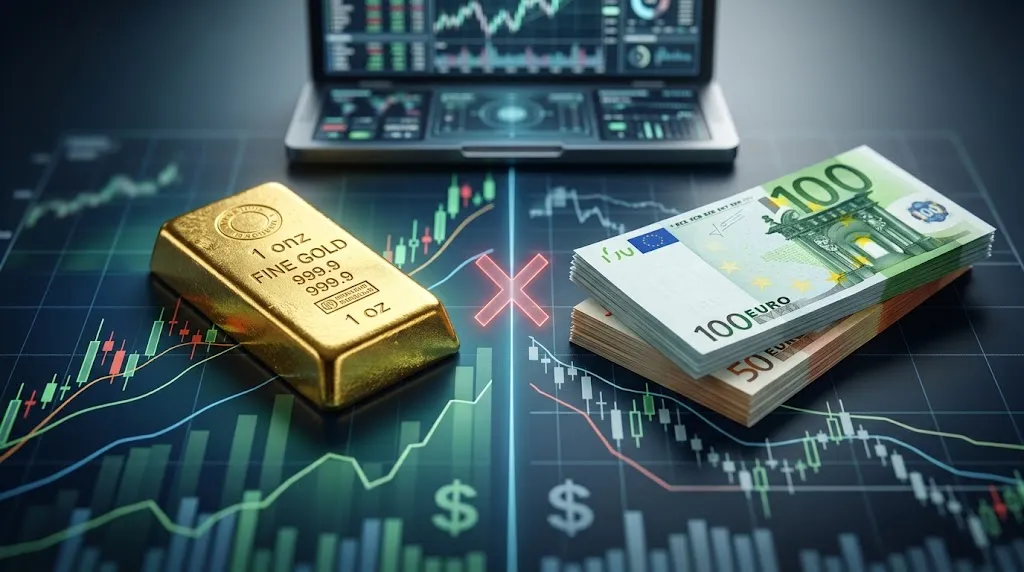
Put the two charts side by side and it jumps out at you: when gold rises, the euro rises. The temptation is immediate — if gold moves first, you have a leading signal. We measured it across 1,449 days and 31,681 hours of our own bars, and the answer is uncomfortable: the correlation is huge, it is real, and as a signal about the euro it is worth precisely nothing.
Do they really move together?
They do, and strongly. On daily closes from January 2021 to August 2026, the correlation between gold (XAU/USD) returns and EUR/USD returns is +0.393. On hourly bars, across all 31,681 hours in the sample, it comes out at +0.369 — essentially the same.
To place that on the −1 to +1 scale we used in the post on currency correlation: between +0.3 and +0.7 is a real but partial relationship. A sustained +0.4 across nearly six years is not one lucky window.
So far, your eyes were right.
What happens when we take the dollar out?
Here is the problem, and it is exactly the one you already know if you read that post: two things move together when they share an engine. EUR/USD and GBP/USD move together because both have the dollar inside them.
Gold has the dollar inside it too. It is priced in dollars. When the dollar weakens it takes more dollars to buy the same ounce — gold rises — and more dollars to buy one euro — EUR/USD rises. Neither one said anything about the other. Both said the same thing about the dollar.
The way to check this is called partial correlation: build a measure of the dollar from the other major pairs, strip its effect out of both series, and measure what is left over. It asks "is there anything between gold and the euro after the dollar has been accounted for?"
This is what is left:
| Measure | Daily | Hourly |
|---|---|---|
| Raw correlation | +0.393 | +0.369 |
| After removing the dollar | −0.014 | +0.000 |
Zero. Not "small" — zero. On daily data that −0.014 has a 59% chance of coming out that big or bigger by pure chance even if no relationship exists at all. And on hourly data, with 31,681 observations — a sample where a mere +0.02 would already be detectable — the result is +0.000.
The entire relationship between gold and the euro was the dollar.
The test that needs no statistics
You could reasonably object that the result depends on how we built our dollar measure. There is one check that depends on nothing, and you can run it yourself on any platform.
If gold knew something about the euro, it would have to show up against currencies that are not the dollar. Crosses exist for exactly this purpose: EUR/GBP, EUR/CHF and EUR/JPY are the euro with no dollar anywhere in sight.
| Gold against… | Correlation |
|---|---|
| EUR/USD | +0.393 |
| EUR/GBP | −0.058 |
| EUR/CHF | −0.111 |
| EUR/JPY | −0.060 |
Take the dollar out of the quote and the relationship does not weaken — it vanishes and flips sign. No controls, no partial correlations, nothing that can be misspecified.
And notice which of the three is largest: EUR/CHF, at −0.111. That is no accident. The Swiss franc is the market's other great haven, so when gold rises the franc tends to rise with it — and EUR/CHF falls. The footprint gold leaves once you remove the dollar does not point at the euro: it points at the havens. Hold that thought, because it comes back two sections from now.
But does it lead? That is the question that matters
A contemporaneous correlation, however large, is not tradeable: it tells you what is happening on both screens at the same moment. For gold to be a signal, it would have to move first.
We measured it hour by hour, then day by day:
| Gold moves… | Correlation with EUR/USD afterwards |
|---|---|
| 1 hour earlier | −0.011 |
| 2 hours earlier | −0.002 |
| 3 hours earlier | −0.010 |
| 6 hours earlier | +0.007 |
| 12 hours earlier | −0.005 |
| 1 day earlier | +0.004 |
Nothing, at any horizon. The largest of the 84 tests we ran — seven lags, four pairs, and gold, silver and bitcoin — was 0.017. It just clears the threshold you would apply to a single isolated test, 0.013, but not the one that running 84 at once demands, which is 0.023. And even granting it the benefit of the doubt, the decisive check finishes it off: we took the best lag for each combination over 2021-2024 and carried it into 2025-2026. None of the twelve repeated, and nine flipped sign.
We added a Granger causality test, which asks whether an asset's past helps explain a pair's present beyond the pair's own past. Of the eight hypotheses — gold's four and bitcoin's four, which we ran together — zero survive the correction for having run many tests at once.
What does survive
Not everything dies, and what remains makes economic sense. Here is where the franc clue returns.
Gold and the yen do share something, and it is not the dollar: −0.143 against USD/JPY once the dollar is out, and −0.197 once silver is out too. They are the two classic safe havens. When fear arrives both rise together (and USD/JPY, which is the dollar against the yen, falls) for a reason that has nothing to do with the greenback. It is the cleanest relationship in the study — and it is still not a leading signal, just a read on the regime.
The commodity channel, on the other hand, does not belong to gold. It belongs to silver. Almost nobody measures this, because gold and silver are correlated at +0.775 with each other and it is easy to mistake one for the other. Forced to compete for the same channel, silver holds +0.197 against the Australian dollar after removing both the dollar and gold, while gold drops to −0.071. Gold was along for the ride.
The bottom line
Gold is not a signal about the euro. It is another way of looking at the dollar — and at real yields, its other great engine — and at that it is excellent, as we wrote when it broke $5,000.
That is where the practical consequence lands, and it is the correlation post's trap wearing a different costume: if your thesis is that the dollar weakens, you have already expressed it through the dollar index (DXY) and through the pair itself. Adding a gold position diversifies nothing — it is the same bet placed twice, paying two spreads.
Not every asset gives the same answer, incidentally: we put bitcoin through exactly the same tests and it clears the first one — strip the dollar out and a relationship of its own does survive, though it leads nothing either.
And the lesson travels further than gold: a correlation is not a signal, and a contemporaneous correlation is not a leading indicator. Before you accept any correlation somebody shows you, ask it this article's two questions — is anything left once the shared engine is removed, and does it hold at a lag? Almost none survive both.
How this was measured: our own bars from January 2021 to August 2026, sampled at the 17:00 UTC close — 1,449 daily and 31,681 hourly observations across EUR/USD, GBP/USD, USD/JPY and AUD/USD, plus gold, silver and the EUR/GBP, EUR/CHF and EUR/JPY crosses. "The dollar" is an index we build from the remaining major pairs in each case, not the DXY. The lead tests are estimated on 2021-2024 and checked on 2025-2026; the hourly figures in the lag table come from the estimation window. Below one hour we have not measured it: our smallest bar is hourly. It is a sample, not a law of the universe.