
Education· page 4
195 articles

What is Jackson Hole, and why does it move currencies?
The Economic Policy Symposium the Kansas City Fed has hosted in Wyoming since 1982 — how a farming conference became the stage where central banks trail policy shifts?, and what actually moves in forex when they do?

What is the COT report and how do you read it?
The official count of who holds what in US currency futures. The CFTC publishes it every Friday with data from the preceding Tuesday. What does each category measure, how do you read an extreme, and how much delay does it really carry?
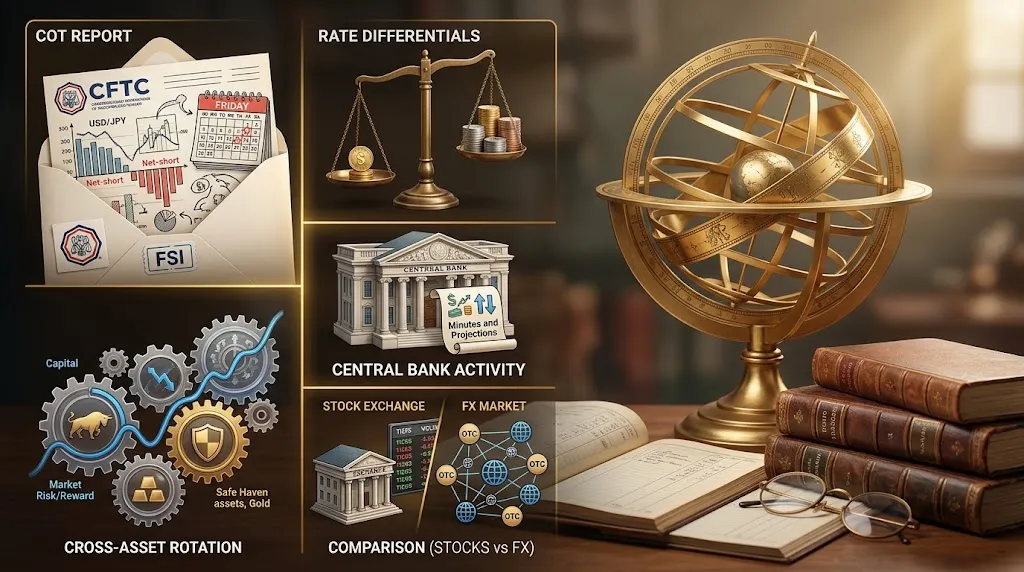
What does "following the money" mean in forex?
The advice is good and almost everything sold under that name in forex cannot be seen. Spot has no central exchange, so there is no real volume and no tape. Here is the money you can actually follow: public, free and delayed.

Is forex a zero-sum game?
The accounting is, trade by trade. The intent is not. 42% of volume is funding swaps and 2025’s growth came from hedging — but among those who speculate, once costs are in, the game is negative-sum.

Why does almost nobody make money day trading?
Between 67% and 97% of intraday traders lose money. The cause is not that markets are unpredictable: the gross result hovers around zero and what sinks it is cost, which scales with frequency.

What does a trading bootcamp actually sell you?
The information is free. What you pay for is a schedule, a group, and someone who reads your trades — and it is worth knowing which of those you actually need.

What is the Bank of Canada (BoC)?
The BoC sets the rate behind the Canadian dollar, and it is the one major central bank whose inflation target is renewed by agreement with the government every five years.

What is the Reserve Bank of Australia (RBA)?
The RBA sets the cash rate that drives the Australian dollar. Its inflation target is a band rather than a point, and its rate moves reach households faster than almost anywhere else.

What are the consumer confidence indexes (Michigan and Conference Board)?
Two monthly surveys ask American households how they feel about the economy. One of them carries the inflation-expectations number the Federal Reserve reads most closely.

Trailing stops: when do they protect a trade and when do they cut it short?
A trailing stop follows price and never moves back. Set the distance from volatility rather than a round number, and know what it really does: it does not maximise the winner, it protects it.

Order book and depth of market: why does forex not have one?
Forex has no central order book because it has no central exchange. That one structural fact explains tick volume, broker-specific spreads and why institutional orders cannot be verified.

Expectancy, Sharpe and Sortino: the metrics beyond win rate
Win rate tells you how often you are right, not whether you make money. Expectancy answers whether the edge exists; Sharpe and Sortino tell you what it cost to collect it.

Moving averages: what do SMA, EMA and the crossovers really tell you?
A moving average is the average price over the last N bars. That simplicity is the point — and it is why the signals built on top of it, golden and death crosses included, are so often misread.

What is the dollar index (DXY) and what does it really measure?
The DXY tracks the dollar against six currencies, but its weights were set in 1973 and never updated. What is actually inside it, and why it sometimes disagrees with the dollar in front of you.

Does SMC actually work? What it can and cannot claim?
SMC describes real things on a chart, but cannot prove the story it tells about them. What the framework can honestly claim, what it cannot, and how much of it is genuinely new.

What is the VIX and why does it move forex?
The VIX measures the movement the options market expects in US stocks. It is not a currency indicator — and yet it is one of the cleanest early warnings that risk appetite is about to turn.

How to spot a fake AI trading signal service?
A legitimate signal service shows a verified, third-party track record with drawdowns and never guarantees returns. A scam hides behind a black-box "proprietary AI" and cherry-picked screenshots. Here is the checklist.

Should you share your trading strategy with an AI?
When you paste your strategy, journal or positions into a cloud AI, that data leaves your computer and lives on someone else’s servers. Here is what actually happens to it — and when to use a local model instead.

