Market, limit and stop orders: which one should you use and when?
Mastering forex trading requires understanding three core order types: use a market order for immediate execution at the current price, a limit order to buy below or sell above…
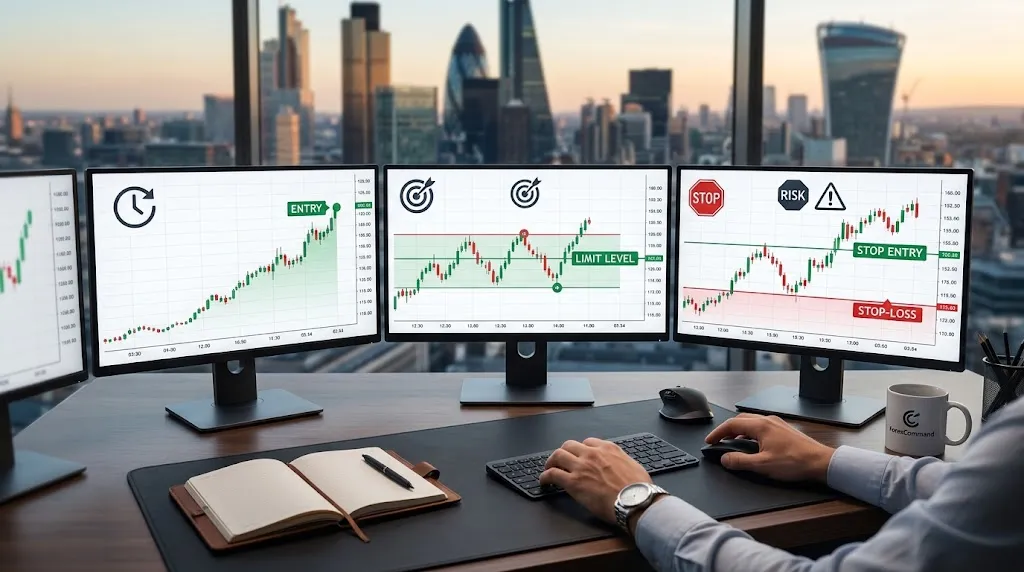
Mastering forex trading requires understanding three core order types: use a market order for immediate execution at the current price, a limit order to buy below or sell above the current price for a better entry, and a stop order for essential risk management (stop-loss) or to enter trades on a breakout.
What is a market order, and when should you use one?
A market order is the simplest way to trade, instructing your broker to buy or sell immediately at the best available current price. You are essentially saying, "I want in (or out) right now, whatever the price." This ensures instant execution, but the exact fill price might differ slightly from what you see on your screen due to slippage, especially in fast-moving markets.
Use a market order when speed is your priority, and you are willing to accept the current price. This is ideal when reacting quickly to breaking news, entering a strong, confirmed trend you don't want to miss, or simply closing a position without specific price targets.
What is a limit order, and when should you use one?
A limit order lets you specify an exact price at which you want to buy or sell. For a buy limit order, you set a price below the current market price, hoping the price will drop to your desired level before executing. For a sell limit order, you set a price above the current market price, expecting the price to rise. Your order will only fill if the market reaches or crosses your specified price.
Limit orders are best for disciplined entries, aiming for a better price than currently available. They are perfect for trading pullbacks within a trend or attempting to fade an extended move. While they offer price control and can improve your risk-reward ratio, there’s no guarantee your order will fill if the market never reaches your set price.
What is a stop order, and when should you use one?
A stop order becomes a market order once a specific "stop price" is triggered. It serves two main purposes:
1. Stop-Loss: The most critical use. If you are long, a sell stop-loss is placed below your entry. If you are short, a buy stop-loss is placed above your entry. When the market hits this price, your stop order turns into a market order to close your position, limiting potential losses.
2. Stop-Entry: Also known as a "buy stop" or "sell stop" entry. A buy stop is placed above the current market price to enter a long position on a breakout. A sell stop is placed below the current market price to enter a short position on a breakdown.
Stop orders are fundamental for risk management and breakout strategies. For example, if you have a $10,000 trading account and decide to risk 1% ($100) per trade, you can use a stop-loss to define your maximum loss. If you buy EUR/USD at 1.08500 and place a stop-loss at 1.08400 (a 10-pip risk), you can calculate a position size of 1 standard lot to ensure your $100 risk limit is met (10 pips * $10/pip per standard lot = $100). Remember, these numbers are illustrative and do not guarantee future performance. The MRS tells you how active conditions are right now — it does not tell you whether a breakout will follow through.
What is a common beginner mistake with stop orders?
A frequent beginner mistake is setting stop-loss orders too tightly or too arbitrarily. Placing your stop-loss just a few pips away from your entry, without considering market volatility or significant support/resistance levels, can lead to your trade being "stopped out" prematurely. The price might briefly dip past your stop, only to reverse and move in your favor.
Always place your stop-loss at a logical price level, allowing the trade some room to breathe, but not so wide that it violates your risk management rules. A well-placed stop-loss is essential for capital preservation, and understanding how much price moves in one minute, or over a typical trading session, can help inform this decision.