What was the 2022 yen intervention?
Japan spent ¥9.19 trillion on three separate days, and after the first round the dollar still hit a 32-year high against the yen. What was the 2022 yen intervention, and what finally turned the yen?
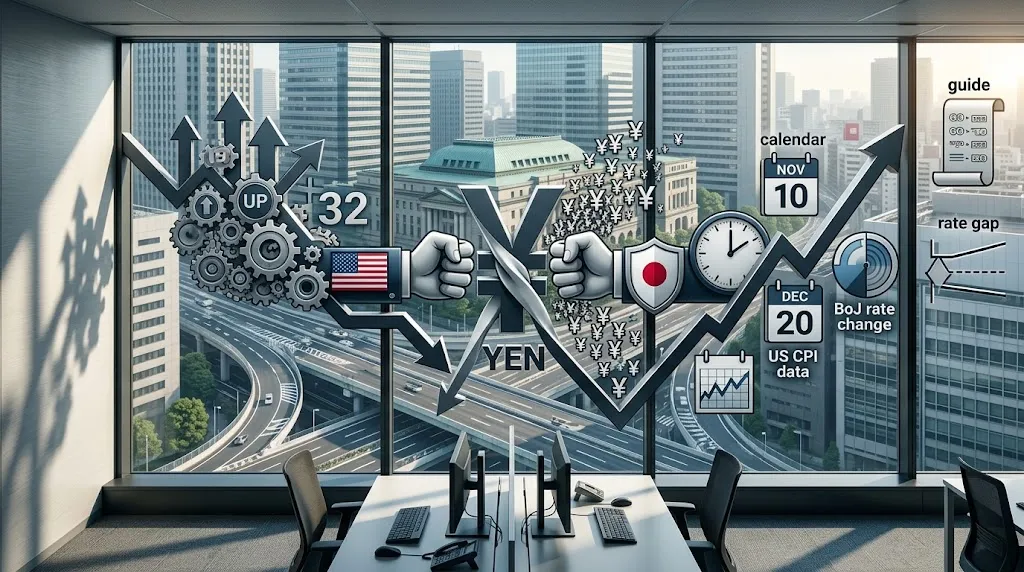
In the autumn of 2022 Japan bought yen for the first time since 1998, spending ¥9.19 trillion on three separate days. The first round did not stop USD/JPY from printing its highest level in 32 years a month later. The money capped the top; what turned the trend was the rate story.
Why did Japan step in?
Because the rate gap had become a one-way street. On 21 September 2022 the Federal Reserve raised its target range to 3.00–3.25%, its fifth hike of the year. The next day the Bank of Japan (BoJ) left its policy rate at −0.1%.
USD/JPY, which had started the year near 115, touched 145.90 that afternoon.
What happened on 22 September?
Around 5 p.m. Tokyo time the pair fell from 145.84 to 140.69 in a single hourly bar of our price data. Masato Kanda, Vice Minister of Finance for International Affairs, told reporters Japan had "taken decisive action".
The ministry's own record puts the bill at ¥2.84 trillion for that one day, above the previous single-day record for yen buying, ¥2.62 trillion in April 1998. Less than three weeks later the pair was back above 145.90. The money changed the price; it did not change what holding yen paid compared with holding dollars.
Why was October different?
On 21 October USD/JPY reached 151.94 and this time Tokyo said nothing. The yen's surge began around 10:30 a.m. New York time, long after Japanese markets had closed, and in under three hours the pair fell from 151.64 to 146.19. Kanda would not say whether Japan had intervened.
On Monday, at 8 a.m. in Tokyo, the pair dropped from 149.71 to 145.55 inside an hour. Neither move came during Tokyo's trading day: the first landed near midnight Japanese time, the second before the Tokyo open, in the thin liquidity of early Monday.
The ministry's data later showed ¥5.62 trillion on 21 October, a new single-day record for yen buying that stood until April 2024, and ¥0.73 trillion on 24 October. That is a stealth intervention: official money, no announcement.
| Date | Yen bought | USD/JPY that day: high → low |
|---|---|---|
| 22 Sep 2022 | ¥2.84 trillion | 145.90 → 140.35 |
| 21 Oct 2022 | ¥5.62 trillion | 151.94 → 146.19 |
| 24 Oct 2022 | ¥0.73 trillion | 149.71 → 145.55 |
So what turned the trend?
Two scheduled events that moved the rate story. On 10 November the US consumer price index (CPI) came in at 7.7%, below forecasts, and USD/JPY fell from 146.59 to 140.20 that day.
On 20 December the BoJ widened the band around its 10-year yield target from ±0.25 to ±0.5 percentage points, a move none of the economists in Bloomberg's survey had expected. The pair dropped from 137.47 to 130.57 and ended the year near 131.
The 151.94 top held until March 2024. In November 2023 the pair got to 151.91, a few pips short, and the ministry's record shows no operation that year.
What can a trader take from it?
- Intervention caps the pace; the gap sets the direction. The 2022 episode is the clearest example of the argument in our guide to currency intervention.
- Silence is a tactic. September was announced; October was not, and its day-by-day breakdown only came out in February 2023.
- The turn came from the calendar. The interventions landed at hours nobody could predict; the reversal came from a CPI print and a BoJ meeting.
- It was not the last time. Japan bought yen again in 2024 and twice in 2026: in the spring, which did not stop the yen's slide to 162, and again from the end of July, partly coordinated with the US Treasury. The rate gap behind the weak yen was still wide.
Amounts and dates are the Ministry of Finance's official record (Foreign Exchange Intervention Operations, plus its monthly releases through 28 September 2026). USD/JPY levels are hourly bars from our own price data. Kanda's remarks, the New York timing and the Bloomberg survey are as reported at the time; the coordination with the US Treasury was confirmed by Japan's Ministry of Finance and by Treasury Secretary Scott Bessent.