What was the Bretton Woods system?
In 1944, 44 nations tied their currencies to the dollar and the dollar to gold at $35 an ounce. What was the Bretton Woods system, and why did it end?
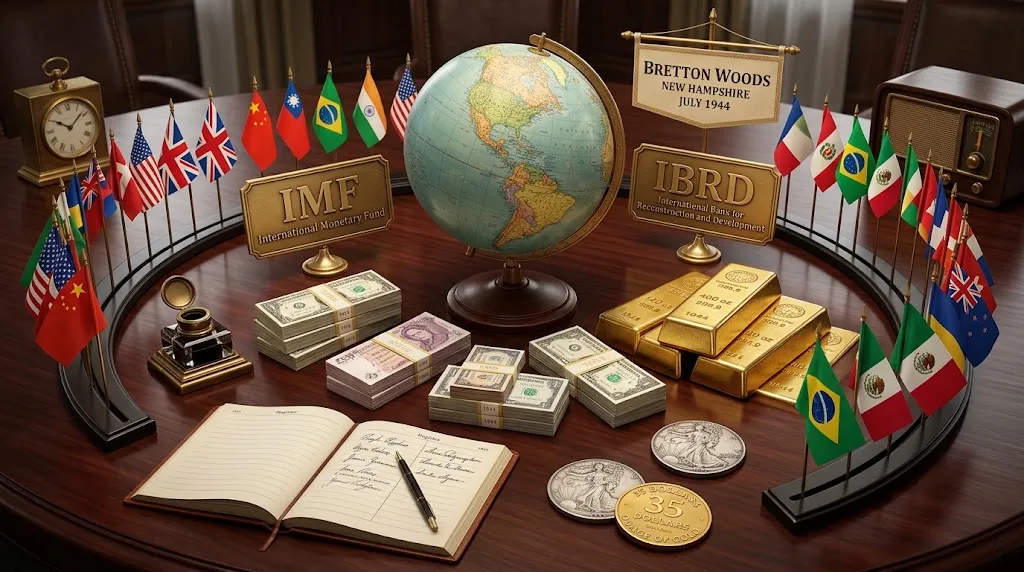
In July 1944, with the war still being fought, 730 delegates from 44 nations met at a hotel in New Hampshire to decide what money would be worth once the fighting was over. Their answer held until 1971: other currencies tied to the dollar, and the dollar tied to gold at $35 an ounce.
What did they agree on?
The conference, at the Mount Washington Hotel in Bretton Woods, built a system of fixed but adjustable exchange rates. Each currency was pegged to the dollar within a 1% band, and the dollar was fixed to gold at $35 an ounce.
It also created two institutions that still exist: the International Monetary Fund (IMF), to watch exchange rates and lend to countries short of reserves, and the International Bank for Reconstruction and Development, now part of the World Bank Group.
John Maynard Keynes, for Britain, proposed a clearing union with a currency of its own, the "bancor". The final plan looked more like the smaller fund put forward by Harry Dexter White of the US Treasury.
Was it a gold standard?
Not in the old sense. The United States had suspended its domestic gold standard in April 1933, and in January 1934, using powers from the Gold Reserve Act, Roosevelt moved the official price from $20.67 to $35 an ounce.
Under Bretton Woods, it was foreign governments, not private holders, that could turn dollars into gold. So the question of when the gold standard ended has two answers: 1933 for Americans, and 15 August 1971 for foreign governments.
Why did it break?
The system needed dollars abroad to work, and the more of them piled up outside the United States, the less credible the promise to swap them for gold became. Economists call this the Triffin dilemma.
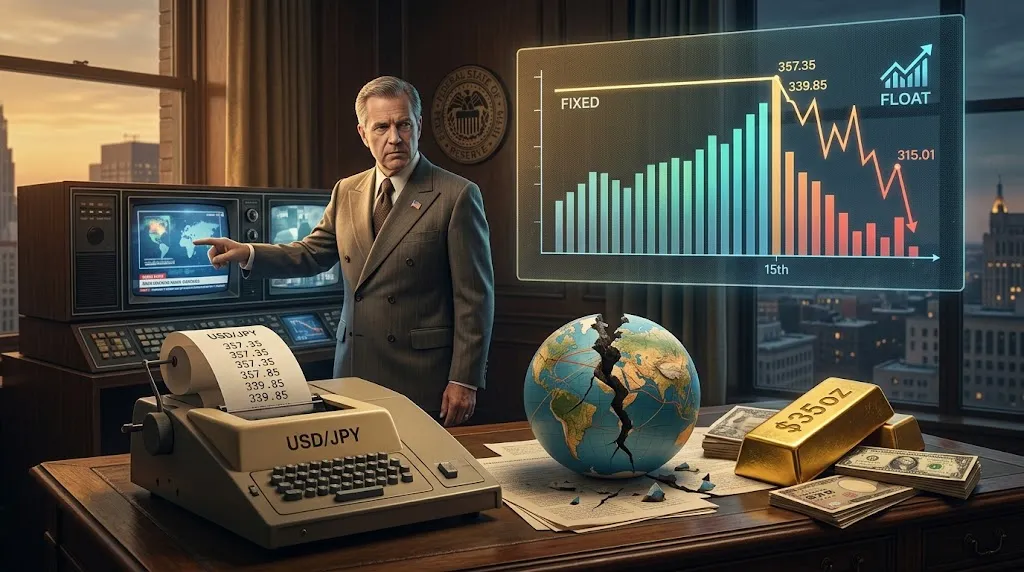
Eventually, foreign-held dollars exceeded the US gold stock. The London Gold Pool, formed by eight central banks in 1961 to hold gold at $35, collapsed in March 1968. On 15 August 1971 President Nixon closed the gold window, the episode we tell in our story of the Nixon shock.
The Smithsonian Agreement of 18 December 1971 tried to save fixed rates with gold at $38. In February 1973 the dollar was devalued again, to $42, and in March generalized floating began.
Why do the major currencies float today?
Because nobody rebuilt the peg. In April 1978 an amendment to the IMF's Articles of Agreement gave each member the right to choose its own exchange arrangement: floating stopped being an emergency and became a choice. The major currencies chose to float; not every currency did.
What survived was the dollar's place at the centre. The dollar index starts in 1973 at 100, when there was finally a market to measure, and the dollar still sits on one side of about 89% of currency trades, as our breakdown of the dollar's dominance shows. Gold has an afterlife too: central bank buying is the most visible face of de-dollarization.
Bretton Woods made the dollar the anchor, and its end turned the major exchange rates into prices rather than policies. The dollar is still the yardstick they are measured against.
Conference figures, the peg, the 1% band, the 1933 suspension, the Triffin dilemma, the London Gold Pool and the $38 and $42 gold prices: Federal Reserve History. The dates of August and December 1971, March 1973 and April 1978: the IMF's own chronology. The 1934 gold price: the White House statement on Proclamation 2072 (American Presidency Project). The 89%: the Bank for International Settlements' Triennial Survey of April 2025. The dollar index's base of 100 in March 1973: Intercontinental Exchange (ICE), which publishes the index.